#30 -La scienza e la tecnica della cosa


Have you ever wondered about the ''Teapot effect''?


When searching for a possible relation between teapots and science, I found an interesting paper dealing with the problem of dribbling teapots. In fact, everyone has experienced the annoying overflowing from the pot spout especially when the tea is poured slowly. Therefore I summarized the main points of this article and I also attached the link to download the full paper.
For centuries scientists have struggled to explain the ''teapot phenomenon''.Some suggested internal vortices in the fluid, others opted for atmospheric pressure as the main factor while other explanations based on the momentum of the fluid tried to find the perfect speed of the flow to avoid the dribbling.
A team of fluid dynamics scientists, C. Duez, C. Ybert, C. Clanet, and L. Bocquet, from the University of Lyon in France have addressed this issue by explaining the main factor of overflowing: a "hydro-capillary" effect that sticks the liquid to the solid surface as it is poured from the spout. The experts emphasised that to avoid this problem one way is to design the lip of the spout very sharp and coat the lip with superphobic materials to repel water from the spout. I reported below some pictures to explain the experiment :


In (a) when water leaves the spout of an (hydrophilic) teapot, the streamline bends and causes the dribbling , and this is worst at a slower flow rate(a').However, when using a superhydrophobic coating the streamline is straight and the dribbling problem is avoided at different flow rates b and b' .


link2:The source of the picture

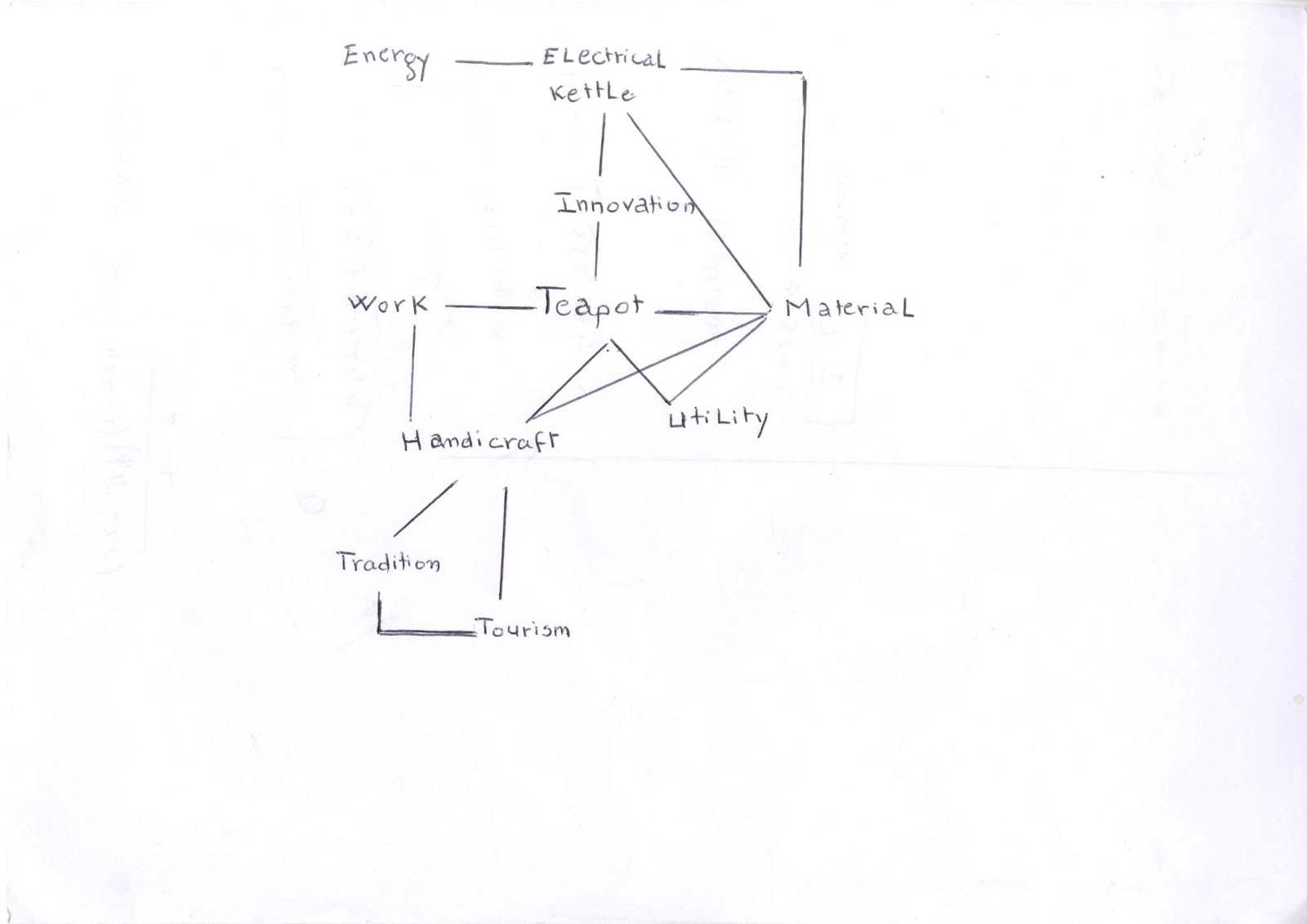
#16 - Una prima mappa concettuale

                                       A conceptual  map


#19 La cosa nell'Arte

''The Crab teapot''  pottery sculpture


Teapots have inspired for centuries artworks in all fields including sculpture and oil painting.
Mitchell Crafton is a contemporary artist who is the author of many creature teapots and one of these artworks is ''The blue crab teapot''. This piece is 2.54 cm wide and 18 cm tall and the legs are made of metal .


The author: Mitchell Grafton

The location: Panama City, Florida,


''Still life ,with teapot, cup and fruit'' painting


Another important field predominated by teapots is painting. ''Still life ,with teapot, cup and fruit'' is the achievement of the French Post-Impressionist painter Emile Bernard in 1890 who  had artistic friendship with Van Gog . This artwork is currently  in Van Gog Museum in Amsterdam.


The author :Emile Bernard

The location: Van Gogh Museum in Amsterdam


link1:The carb teapot sculpture
link2:Émile Bernard , ''Still life with teapot, cup and fruit'', 1890


#26 - La cosa sui francobolli


Teapots on stamps


Teapots are a popular topic for stamps and this is enjoyable way to learn about cultures and origins of objects because each of the teapots has its name as well as the country of origin on the stamp. Although I found normal that the majority of teapots stamps came from China, I was struck by the sheer number of worldwide stamps available.


link1:The source of pictures

#28 - Il protagonista della cosa

  Tokoname Master craftsman : Hokujo Genji Shimuzu


Hokujo Shimizu is one of the most brilliant teapots maker in the state of Tokoname in Japan. His talent won him the title of '' Tokoname Master Craftsman'' in 1991 as well as many awards such as: "Japan Traditional Crafts Art Exhibition''. I attached below one of his favourite teapots. 


In the video below , one can  watch  Shimizu Genji making  the Kysu(the Japanese teapot), in his   studio in Tokoname.

link1:Tokoname Master Craftsman making Kysu(Japanese tepaot)
link2:Hokujo profile

#21 - La cosa nella Musica

   The teapot in Music

When  looking for   teapots in the musical world, I found that they were mainly the subject of popular nursery rhymes  and traditional poems for children  dating back to the nineteenth century. I have chosen  '' I am little teapot'' and '' Polly put the kettle on''


                                    '' I'm a little teapot''


''Polly put the kettle on''


link1:I'm little teapot'',Song and Lyrics
link2:Gus Williams ''Popular songs'', teapots
link3:Polly put the kettle on
link4''Polly put the kettle on '' Lyrics

#32 - Le azioni della cosa / con la cosa

                           The actions of /with the teapot

                                                                        To boil:
                                                        (To boil  water in a teapot)


                                                                     To brew:
                                                       ( To brew a tea in a teapot)

                                                                  
                                                                     To contain:
                                                         (The teapot contains tea)
                                                                   To dribble:
                                                            (the teapot dribbles)
                                                  
                
                                                                    To drip:
                                                              (The teapot drips)

                                                                      To hold:
                                                   (The teapot holds 4 cups of tea)
                                    

                                                                   To pour:
                                                         ( The teapot pours tea)


                                                                To scream:
                                                         (The teapot screams)


                                                                 To steep:
                                              (To steep tea leaves in a teapot)


                                                                 To sweat:
                                                  (The teapot sweats drops)
                                            
              
                                                               To whistle:
                                                       (The teapot whistles)

#29 - I numeri della cosa

 The numbers of the teapot


Most of the numbers associated to teapots I found in the web are lot numbers which are an identification assigned to manufactured single pieces. For example, these two Chinese Yixing teapots have each a lot number respectively 1078 and 1434.


In addition to the previous examples ''Utah teapot''  made by the computer designer Martin Newell
is associated with a catalogue number  X 398.84.


The Igenix  kettle  has a capacity of 3.5 litres , therefore 3.5 could also be a teapot number.


The fourth  example is the  certificate of authenticity  which is included with a pot and contains an authenticity number such as 5090.


link1:The source of the pictures
link2:Utah teapot number
link3:Igenix Corded Catering Kettle 
link4:The authenticity number

#15 - L'evoluzione futura della cosa

The future evolution of the teapot


Although I already mentioned in the previous sections that the kettle was  an innovative version of the teapot, I found some other innovative teapots like the ''Sorapot teapot ''of the American designer Joey Roth. Made of stainless steel  and glass,  the Sorapot allows the hot water to immerse the whole surfaces of the leaves  and ensure that the tea  gets  the full flavour. I attached below a video explaining how to use a sorapot.


link2:How to use a sorapot

#17 - La nuvola dei nomi

                       The cloud of names related to ''teapot''


When looking for names related to the teapot, I found these beautiful illustrations. The first teapot cloud is predominated by the plants(mint and tea leaves) used to make traditional Chinese infusions, the second cloud deals with the evolution of the teapot over the world, while the third includes some aliments that accompany tea such as sugar and biccie as well as some adjectives for tea like ''cosy'' and ''strong''.


link1:The source of the pictures

#31 - L'ABC della cosa

The ABC of the teapot


             Alessi teapot

A-Alessi Teapot: Alessi is a kitchen utensil company in Italy and one of its famous products are teapots.


Brown Betty teapot


B-Brown Betty teapot: is an English teapot with a rounded shape. It is reputed for its excellent heat retention due to the red clay.


            Cube teapot

C-Cube teapot: this a cubic teapot especially designed to be used on a ship. Its cubic shape stabilise it and prevents it from rolling over.


         Dammann teaopt

D-Dammann.teapot: is one of the oldest French companies that produces tea and teapots.


Ehrenfried Walter


E-Ehrenfried Walther von Tschirnhaus invented a procedure to make the porcelain in 1708, in Dresden in Germany. Thanks to this scientific breakthrough, European manufactories could produce their own tea ware.


F-Flagstaff House Museum of Teaware: has the oldest teapot in the history which dates back to 1513 and is attributed to Gong Chun.


   Gong Chun teapot

G-Gong Chun teapot: Gong Chun is a Chinese servant of the scholar Jinsha who learned how to make high quality teapots.


The handle of the teapot

H-Handle of the teapot: is the top or the side part that allow to carry the pot.


           The tea infusion

I-Infusion of tea: The infusion is made by adding boiling water to tea leaves. The resulting liquid is the infusion


Jeroen's teapot

J-Jeroen's teapots: Jeroen Betchold is a designer who produced 3D teapots.


   The kyusu

K-Kyusu teapot: is the traditional Japanese teapot, but it is more popular in the state of Tokoname. The spout is designed in such way there is no drop when pouring. 


            The lid of the teapot

L-Lid of the teapot: is the cover of the teapot. It is often crafted with an air hole at the top to avoid the dripping when pouring tea.


          Melitta teapot

M-Melitta teapot: is a German company selling coffee and coffee makers.


                 Newell teapot

N-Newell teapot: Martin Newell is a British computer graphics designers who developed the designs of teapots in Utah University.


        Oigen teapot

O-Oigen teapot:is an ironware firm in Japan that produces teapots and kettles.


Porcelain teapot

P-Porcelain teapot:


Porcelain first emerged in China and then spread to the rest of the world. lt is popular because it can be mixed with glazes and allow a wide range of treatments in vessels.


         Qingbai teapot

Q-Qingbai teapot: is a kind of porcelain extremely used in the Chinese pottery.


  Raku teapot

R-Raku teapot: Raku is a type of traditional Japanese pottery that became also popular in American pottery in the 1950s.


     The Sagittarius

S-Sagittarius: Sagittarius contains a pattern that looks like a teapot.


Twinning teapot

T-Twinning: is an English brand for beverages including tea and coffee.


U-Utah Teapot : is the second name of Newell teapot which is a 3D teapot model desiogned by Martin Newell


          Victorian teapot
V-Victorian teapots: these teapots date back to The Queen Victoria era (1837-1901 ) and have very elegant style.


Walker and Hall teapot

W-Walker and Hall: is a British company that produced electroplated items since 1862. Currently the firm continues to sell silver plates and tea services.


Xinjiang Hojo teapot
X-Xinjiang Hojo: is a Japanese company producing green tea, kettles and teapots.


Y-Yixing teapot: it is the typical traditional Chinese teapot of the 15 th century. It is made with clay from the city of Yixing in Jingsu province in China. Zisha Yixing teapot


Z-Zisha: is the second name of Yixing clay.